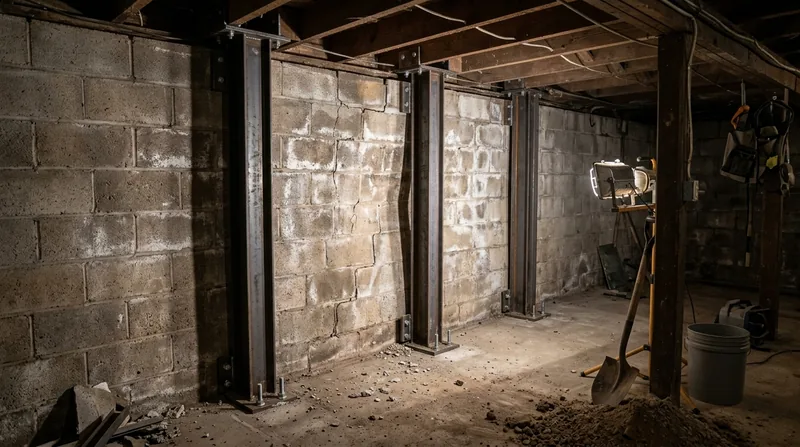




Elgin sits on glacial till and clay loam over dolomite, and that heavy soil holds water against foundation walls long after the Fox River crests and the creeks that feed it drain back down. In Bluff City and along the downtown streets, 1900s to 1930s brick and frame houses still carry full basements built with stone, brick, or early block walls. Those walls were never designed for the hydrostatic pressure that builds up each spring, and after a hard freeze-thaw cycle, a wall that was straight in October can be leaning by April. If you are searching for Bowing Wall Repair in Elgin, the first thing to understand is that a leaning wall is not a cosmetic problem: it is a structural symptom, and it needs to be stabilized before it gets worse. Start with a free basement inspection so we can measure the movement instead of guessing at it.
Why Bowing Walls Are So Common in Elgin's Older Basements
The dominant failure mode in Elgin is a block or brick wall pushed inward by saturated glacial clay, and it shows up most often on the older housing stock in Bluff City and the downtown streets. Those walls are unreinforced masonry, laid in courses with mortar joints that soften over a century of wet-dry cycling. When the ground freezes, the water in the clay expands and drives the wall inward; when it thaws, the wall does not spring back. Most of the ground here drains slowly, so the soil stays saturated well into spring and the pressure never really lets up.
- A wall that bulges inward at mid-height usually means hydrostatic pressure has been building for years, not months.
- Diagonal stair-step cracks in the mortar joints are the classic sign that a block wall is moving.
- Horizontal cracks near the middle of the wall are more serious than vertical ones and call for stabilization, not just sealing.
- Efflorescence, the white salt bloom on the wall face, tells you water has been moving through the masonry.
- A wall that leans more than about an inch over its height needs an engineered repair, not a cosmetic patch.
If you see any of these, stop patching and get the wall looked at, because the movement accelerates once the wall loses its vertical load path.
Key info: On a 1920s block-wall basement off Chicago Street in Elgin, a wall that had bowed about two inches over ten years was still holding, but the mortar joints were crumbling. Carbon fiber straps on the interior face stopped the movement without excavation, and the homeowner kept the finished side of the basement intact.
For the official word on what work requires a permit, check with the City of Elgin building department, since structural foundation repair permits and thresholds vary by jurisdiction and must be verified for your address.
How We Diagnose and Stabilize a Bowing Wall in Elgin
We do not sell a repair before we know what is pushing the wall. On a typical Elgin job, we start by checking the wall for plumb, mapping the cracks, and looking at the grading and downspouts on the outside. Then we look at the water: if the wall is wet and the clay is saturated, stabilizing the wall without addressing the water just buys time. The repair method follows the diagnosis, not the other way around.
- We measure the wall's deflection with a plumb line or laser and record the crack widths so we have a baseline.
- We check the exterior grade, gutter discharge, and any window wells to see where water is entering the soil.
- We inspect the interior for efflorescence, moisture, and any sign of active seepage at the cove joint.
- We recommend carbon fiber straps for moderate bowing, steel I-beams for heavier loads, or wall anchors when the pressure is high and the wall needs to be pulled back.
- We address the water source, because a stabilized wall in saturated clay will keep moving.
The right method depends on how far the wall has moved, how tall it is, and how much load it is carrying, and we explain the reasoning before any work starts.
Key info: A 1950s ranch on Elgin's west side had a partly finished basement with a wall that had bowed after a hard February freeze. The clay behind it was still saturated in March. We installed carbon fiber straps and extended the downspouts, and the wall has held plumb through two spring thaws since.
If the wall is wet as well as bowed, the water problem is usually a drain tile or grading issue, and our interior drain tile system page explains how we relieve that pressure from inside the basement.
Repair Methods We Use and When Each One Fits
There is no single repair for a bowing wall, and the method has to match the severity of the movement and the pressure behind it. Here is how we match the approach to the condition we find in Elgin basements.
| Approach | Description | Best for |
|---|---|---|
| Carbon fiber straps | Straps bonded to the interior face of the wall and anchored top and bottom to stop further inward movement. | Moderate bowing on block walls where the wall is still sound and the movement is under about two inches. |
| Steel I-beams | Vertical steel beams set against the wall and tied into the floor and joists to carry the load. | Taller walls or heavier loads where carbon fiber alone will not hold the wall. |
| Wall anchors | Anchors driven into the soil outside and connected through the wall to pull it back toward plumb. | Walls that have moved more than a couple of inches and need to be straightened, not just held. |
| Epoxy or polyurethane injection | Injection ports set into cracks and sealed with epoxy or expanding polyurethane to close the path. | Non-structural cracks and seeping joints, not a substitute for stabilizing a bowing wall. |
We tell homeowners plainly when simple crack sealing is enough and when the real problem is hydrostatic pressure that needs a drainage fix, because a strap on a wall in saturated clay is only half a repair.
Bowing Wall Repair Cost in Elgin: What to Expect
Bowing wall repair starts at $600 for limited crack injection or a single small stabilization, and most full wall repairs in Elgin run well above that once straps, beams, or anchors are involved. The number depends on how far the wall has moved, how long the wall is, and whether the water source has to be corrected at the same time. A wall that also needs drainage work will cost more than a wall that only needs stabilization.
The factors that move the price are the length and height of the wall, the number of straps or beams required, access to the interior face, and whether the repair includes exterior excavation for anchors. Older stone and brick walls in Bluff City often take more labor than poured concrete walls in the newer subdivisions, because the surface has to be prepared before anything bonds to it. Getting two or three estimates is smart, and it is the best way to compare what each contractor is actually proposing to do.
Our full pricing overview breaks down the ranges in more detail, and the on-site estimate is free.
What to Look For When Hiring a Bowing Wall Repair Contractor Near Elgin
Hiring for a structural repair is different from hiring for a cosmetic job, and the questions you ask should reflect that. A contractor who cannot explain why the wall is moving, or who proposes to seal a bowing wall without stabilizing it, is not the right call. Here is what we suggest homeowners check before signing anything.
- Confirm the contractor is licensed and insured, and ask for a certificate of insurance before work begins.
- Get two or three written estimates that describe the method, the materials, and the scope in plain language.
- Ask for references from jobs in Elgin or the surrounding Fox Valley towns, and call them.
- Ask who pulls the permit, because structural foundation repair commonly requires one and the rules vary by jurisdiction.
- Make sure the estimate says whether the water source is being addressed, since a stabilized wall in wet clay will keep moving.
A good contractor will tell you when a repair can wait and when it cannot, and will put the scope in writing.
If you are ready to have the wall looked at, contact us and we will schedule a free inspection at your Elgin address.
Bowing Wall Repair in Elgin: Pricing Guide
| Service | Price | Details |
|---|---|---|
| Crack injection (epoxy or polyurethane) | Starting at $600 | Covers sealing a non-structural crack with injection ports; price rises with crack length and number of ports. |
| Carbon fiber strap stabilization | Starting at $950 | Includes straps bonded to the interior wall face; cost moves with wall length and number of straps needed. |
| Steel I-beam wall stabilization | On estimate | Beams tied into floor and joists; needs an on-site look to size the beams and count the runs. |
| Wall anchor system | On estimate | Exterior anchors and through-wall connections; priced after excavation and soil conditions are assessed. |
| Travel | Included | In Elgin and surrounding Fox Valley towns, no separate call-out or mileage fee. |
| Estimate | Free | Response within 24 hours at (224) 407-3329, no obligation to book the work. |
Indicative pricing, the exact cost depends on square footage, finish, and site access. Free personalized estimate within 24h at (224) 407-3329.


