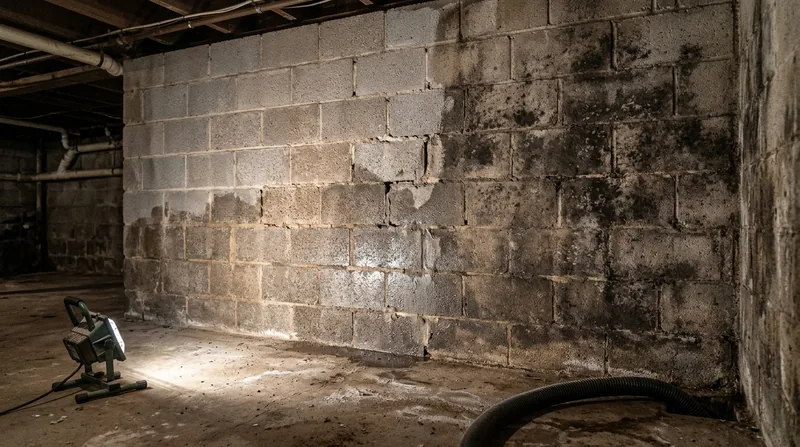




Elgin sits on glacial till and clay loam over dolomite, and that shallow, slow-draining soil is why so many basements in the 1900s brick and frame houses of Bluff City and the downtown streets stay damp long after the rain stops. Spring snowmelt and Fox River floodplain surges push the water table up fast, and the long freeze-thaw winters open new cracks in stone, brick and early block walls. When that moisture sits against a foundation wall or under a basement slab, mold growth starts within days. Basement Mold Remediation in Elgin means two things done together: removing the mold that is already there and fixing the moisture source so it does not come back. We handle both, from containment and surface treatment to the drainage and dehumidification work that keeps the basement dry. If you are seeing dark staining on joists or a musty smell that will not leave, start with a free basement inspection so we can trace the water before we treat anything.
Why Basement Mold Remediation Matters in Elgin's Older and Newer Basements
Most of the mold calls we run in Elgin come from the same handful of failure points. In the 1950s and 1960s ranches and split-levels on the west and north sides, the partly finished basements have paneling and drop ceilings that trap moisture against block walls, so growth shows up behind finishes where nobody sees it. In the 1990s to 2010s subdivisions in South Elgin and Hanover Park, poured concrete walls are tight, but a failed sump pump or a short discharge line during a heavy spring rain leaves two inches of water on the slab overnight. Either way, the mold is a symptom, and treating the visible surface without fixing the source just resets the clock.
- Efflorescence and white salt bloom on block walls tell you water is moving through the masonry, not just condensing on it.
- A musty basement smell that gets stronger after rain usually points to wet framing, insulation or stored material, not the concrete itself.
- Hydrostatic pressure pushing through footing joints and cove seams keeps the bottom two feet of wall wet year after year.
- Clogged or collapsed weeping tile at the footing leaves water with nowhere to go, so it rises under the slab.
- Sump pump failure or a missing check valve sends discharge water right back against the foundation.
We test the moisture, not just the stain, because a dry-looking wall can still be wet an inch in.
Key info: A homeowner in the older streets near downtown Elgin called us about black staining on the rim joist above a stone foundation. The mold was real, but the cause was a downspout that dumped roof water against the wall for years. We remediated the joist bay and extended the downspout, and the staining has not returned. For general guidance on moisture and mold in homes, the EPA mold resources are a solid starting point.
How We Run Basement Mold Remediation in Elgin, Step by Step
Our process starts with finding the water, because remediation without moisture control is a temporary fix. We walk the basement, check the walls, cove joints, floor drains and sump basin, and use a moisture meter and a musty smell diagnostic to map where the damp is coming from. Then we contain the work area, remove and treat affected materials, and correct the source with drainage, sealing or dehumidification as the situation calls for. The order matters: moisture first, then remediation, then verification.
- We inspect the basement and foundation and trace the moisture source, including grading, downspouts and the sump discharge line.
- We set up containment with plastic sheeting and negative air pressure so spores do not spread to the rest of the house.
- We remove porous materials that cannot be cleaned, such as wet drywall, insulation and cardboard, and bag them for disposal.
- We treat affected framing and masonry surfaces with an antimicrobial and HEPA-vacuum the space.
- We correct the moisture source, whether that means crack injection, an interior perimeter drain, a sump pump replacement or better grading.
- We verify with a moisture meter and a follow-up check so you know the basement is actually dry.
If the source turns out to be a wet wall rather than a one-time spill, we often pair remediation with interior drain tile so the slab stays dry through the spring thaw.
Key info: In a 1960s split-level off Summit Street in Elgin, the finished basement smelled musty every March. The culprit was a sump basin that filled and overflowed because the pump had no battery backup. We remediated the lower drywall, installed a battery backup sump pump, and the spring smell stopped.
Remediation Approaches We Use in Elgin Basements
Not every mold job is the same, and the right approach depends on how far the moisture has spread and what the walls are made of. Here is how we match the method to the basement.
| Approach | Description | Best for |
|---|---|---|
| Surface treatment and HEPA cleaning | Antimicrobial treatment of framing and masonry plus HEPA vacuuming of the space. | Light surface growth on joists and block walls with a known, fixable source. |
| Containment and material removal | Plastic sheeting, negative air pressure, removal of wet drywall and insulation. | Finished basements where growth has reached porous materials. |
| Moisture source correction | Crack injection, interior drain tile, sump work or grading fixes to stop the water. | Recurring growth tied to seepage, hydrostatic pressure or pump failure. |
| Dehumidification and ventilation | Sized dehumidifier and air movement to keep humidity in check after treatment. | Tight, poorly ventilated basements in the newer subdivisions. |
Most Elgin jobs combine two or three of these, because the mold and the water rarely stop at one surface.
Basement Mold Remediation Cost in Elgin: What to Expect
Pricing for mold remediation in Elgin starts from $1,500 for a contained, single-area job with a clear moisture source. From there, the number moves with the size of the affected area, whether finished materials have to come out, how many separate spots are involved, and how much drainage or waterproofing work is needed to keep the mold from returning. A small area of surface growth on exposed block is a very different job from a finished basement where wet drywall and insulation have to be removed and the wall behind them dried out.
We always recommend getting two or three written estimates and comparing scope, not just the bottom line. A quote that only treats the visible mold without addressing the water source will cost you again next spring. For a fuller breakdown of how we price this work, see our pricing overview.
Basement Mold Remediation Near Me: How to Choose a Contractor Near Elgin
Mold work is only as good as the moisture diagnosis behind it, so the contractor you hire should be able to explain where the water is coming from before quoting a treatment. Ask whether they are licensed and insured, request the certificate, and check references from jobs in Elgin or the surrounding Fox Valley towns. Ask how they handle permits, since structural foundation repair and work that alters drainage or the sump discharge connection often require a permit from the local building department, and rules vary by jurisdiction and must be verified. If your home is in a subdivision with HOA rules, confirm any exterior work is allowed before it starts.
We are happy to walk you through our scope and answer questions before you commit. Reach out through our contact page to set up a free, no-obligation estimate at (224) 407-3329.
Basement Mold Remediation in Elgin: Pricing Guide
| Service | Price | Details |
|---|---|---|
| Contained single-area remediation | Starting at $1,500 | Includes containment, antimicrobial treatment, HEPA cleaning and moisture source check for one affected area |
| Finished basement remediation | Starting at $2,800 | Adds removal of wet drywall and insulation, bagging and disposal, and drying of the framing behind |
| Remediation with drainage correction | On estimate | Priced after on-site inspection because drain tile, crack injection or sump work varies by basement |
| Travel | Included | in Elgin and surrounding Fox Valley towns, no separate call-out or mileage fee |
| Estimate | Free | Response within 24h at (224) 407-3329, no obligation to book |
Indicative pricing, the exact cost depends on square footage, finish, and site access. Free personalized estimate within 24h at (224) 407-3329.


